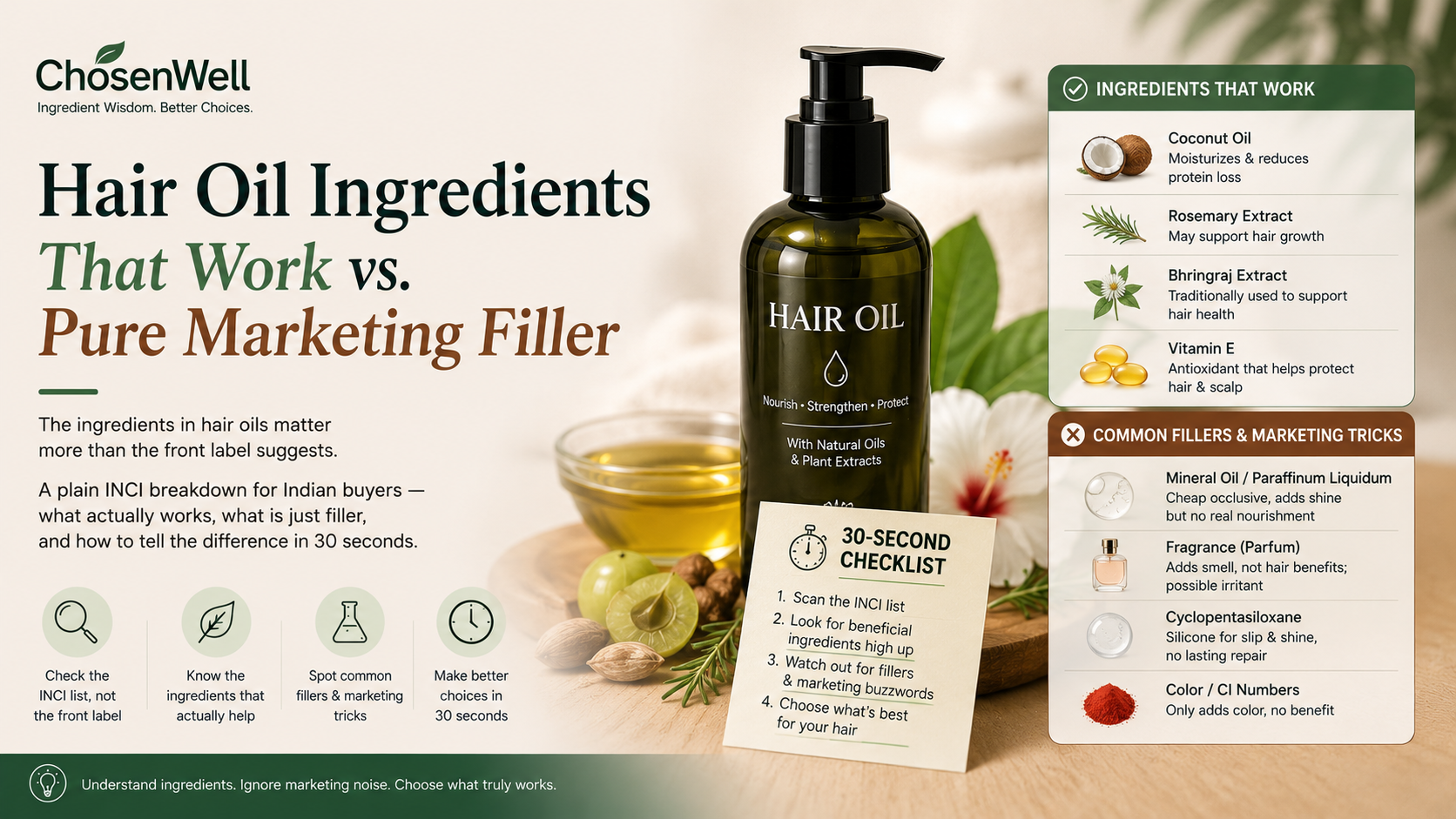
Pick up any hair oil in an Indian pharmacy and the back label reads like an Ayurvedic scripture. Bhringraj, Amla, Brahmi, 24 herbs, 0 fillers. But then there is the INCI list. Water. Mineral oil. Silicone. And a trace of the herb getting the entire front-of-pack treatment. Here is a plain breakdown of what works and what does not.
What Is an INCI List?
INCI stands for International Nomenclature of Cosmetic Ingredients. It is present on every legally sold product in India and lists ingredients in descending order of concentration — highest to lowest.
That order is what matters. The 18th ingredient out of 20 is present in near-undetectable quantities. If the Ayurvedic herb being marketed is towards the bottom of the list, you are buying a story, not a formula.
Ingredients That Actually Make a Difference
Coconut Oil
Cocos Nucifera Oil
One of the rare oils that penetrates the hair shaft rather than just coating it. Studies show it reduces protein loss in hair — something most oils cannot claim. It works, it is affordable, and brands that skip it are usually substituting with something cheaper and worse.
Amla
Emblica Officinalis
High in Vitamin C, beneficial for scalp health, and backed by centuries of Ayurvedic use. The catch: it needs to appear in the first half of the INCI list to be present in a meaningful dose. If it is near the end, it is decoration.
Bhringraj
Eclipta Prostrata
Research supports its effect on hair follicle activity and the growth phase of hair. Useful when present in an appropriate quantity. Seeing it on a label does not guarantee a useful dose.
Sesame Oil
Sesamum Indicum Seed Oil
Contains natural antioxidants and mild antifungal properties that benefit the scalp. Absorbs well and works as a strong base oil that adds real value to a formula.
Ingredients That Are Just Filler
Mineral Oil
Paraffinum Liquidum
A petroleum derivative. It coats the hair, creates immediate smoothness, and is cheap — which is why it is so common. It does not penetrate, does not nourish, and can cause buildup on the scalp over time. If it appears in the top three ingredients of a product calling itself natural, that is a red flag.
Silicones
Dimethicone / Cyclomethicone
Any ingredient ending in -cone or -siloxane is a silicone. They add shine and smoothness but deliver zero nutrition to the hair or scalp. They accumulate over time, are difficult to remove without harsh shampoos, and are used heavily because they mask damage cheaply.
Fragrance
Parfum
No hair benefit. A potential scalp irritant. It is in the formula to make the product smell premium. The closer it appears to the top of the INCI list, the more of the formula is dedicated to scent.
How to Read a Label in 30 Seconds
- 01
Find the INCI list on the back of the product.
- 02
Look at the top 5 ingredients — this is the bulk of the formula.
- 03
If mineral oil, silicone, or water appears before any botanical, the base is filler.
- 04
Find the herbs being advertised on the front. If they appear below position 5, the concentration is too low to matter.
No chemistry degree required. Just know where to look.
ChosenWell evaluates hair oils based on actual INCI data — not front-of-pack claims. Browse the hair oil category to see how products stack up ingredient by ingredient.
Frequently Asked Questions
What does INCI mean on a hair oil label?
INCI stands for International Nomenclature of Cosmetic Ingredients. It lists every ingredient in a product using standardised scientific names, ordered from highest to lowest concentration.
Are silicones bad for hair?
Not harmful in the short term, but they mask problems rather than fix them and cause buildup over time. Most high-quality hair oils do not need them.
Which hair oil ingredients actually support hair growth in India?
Amla (Emblica Officinalis), Bhringraj (Eclipta Prostrata), and Sesame (Sesamum Indicum) have the strongest backing from both traditional use and available research — provided they appear in meaningful concentrations in the formula.