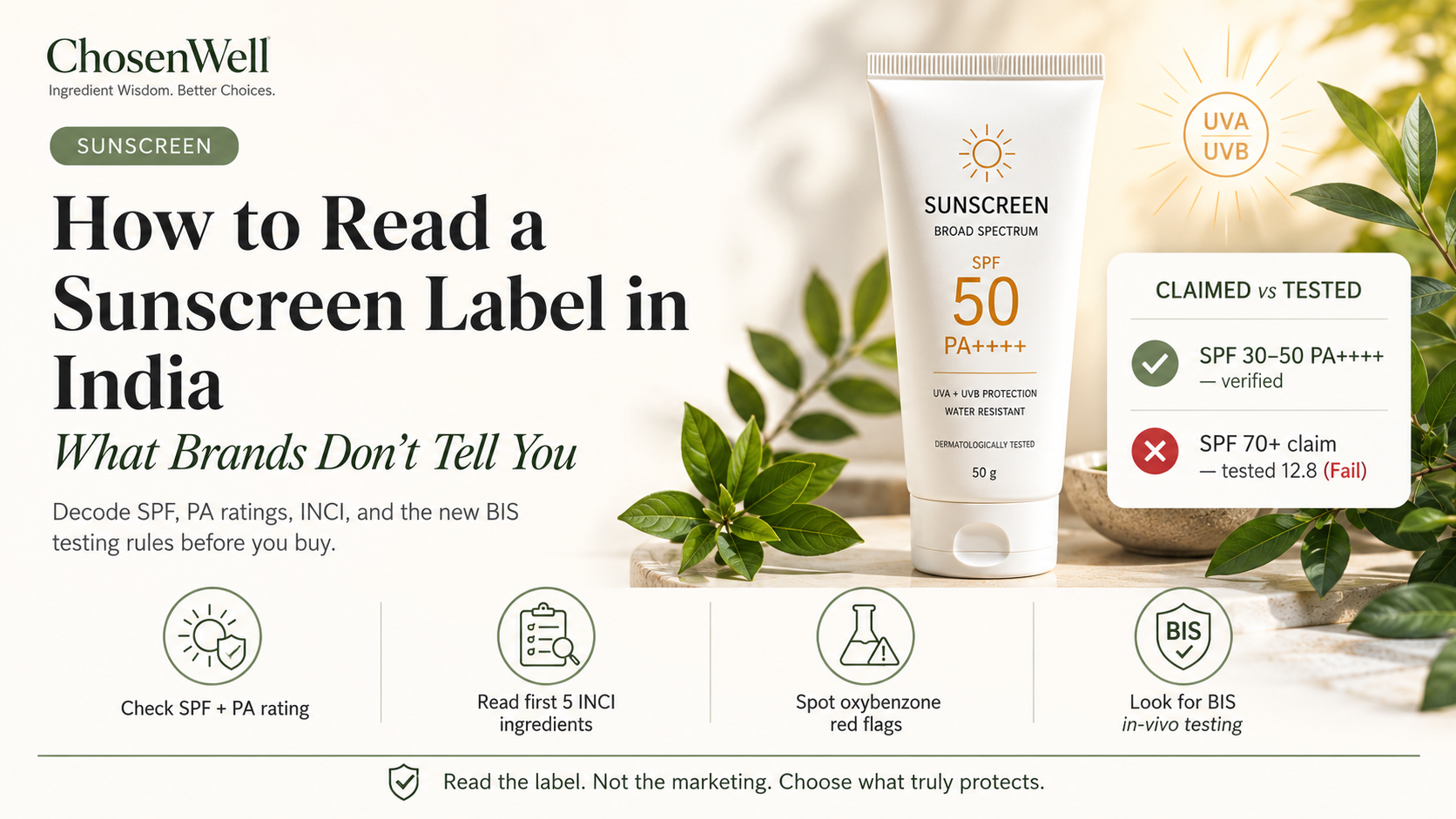
In October 2025, an independent Bengaluru lab tested ten popular Indian sunscreens against the claims printed on their tubes. Six failed. A product labelled SPF 70+ delivered an actual SPF of 12.81. Another labelled SPF 50+ measured 12.94 under ISO 24443 conditions. The gap between what's printed on the front and what reaches your skin is, in plain terms, the difference between sunburn and protection.
This matters more in India than almost anywhere else. The peak UV Index in Bhopal hit 16.73 during a recent monsoon-season measurement — anything above 11 is classified as 'extreme' by the WHO. If you're paying ₹600 for a tube of SPF 50, you deserve to know whether the formula inside actually does what the label promises. Reading that label is now a basic consumer literacy skill, not an enthusiast hobby.
Key Takeaways
- Six of ten top-selling Indian sunscreens failed independent SPF testing in October 2025 (Business Standard).
- BIS now mandates in-vivo SPF testing on every sunscreen sold in India from 10 January 2026.
- PA rating (UVA protection) matters more than SPF for melasma-prone Indian skin — aim for PA+++ minimum.
- Mineral sunscreens (zinc oxide, titanium dioxide) lead 63.36% of Indian sunscreen revenue in 2024.
- Oxybenzone is permitted in India at higher concentrations than the EU allows — check the INCI list.
Why does reading a sunscreen label matter more in India in 2026?
Because the rulebook just changed. From 10 January 2026, the Bureau of Indian Standards (BIS) requires every sunscreen sold in India to pass in-vivo SPF testing — meaning the SPF claim must be verified on actual human skin under ISO 24444 conditions, not estimated from a spectrophotometer reading. BIS also published revised IS 4707 Parts 2 and 3 in August 2025, expanding the lists of allowed UV filters and preservatives (ChemLinked, IS 4707 revisions, 2025).
India also regulates sunscreens as cosmetics, not as OTC drugs like the United States does. That means lower regulatory friction for new product launches, and a heavier burden on consumers to verify what they're buying. The EU restricts several UV filters India still permits at higher concentrations — so an EU 'safe' label and an Indian one aren't directly comparable. Until now, label claims were the brand's word against yours.
"Until January 2026, any brand selling sunscreen in India could lean on lab tests conducted abroad — sometimes on skin types and formulations that bear no resemblance to the bottle going home in a Delhi consumer's bag. The new in-vivo mandate is the single biggest accountability shift the Indian skincare category has seen in a decade."
What does the SPF number on the front actually measure?
SPF measures protection against UVB rays — the radiation that causes sunburn and is the primary driver of squamous cell skin cancer. An SPF of 30 blocks roughly 97% of UVB; SPF 50 blocks about 98%; SPF 100 blocks about 99%. The October 2025 lab investigation found that 6 of 10 tested Indian sunscreens delivered less than half their stated SPF in ISO 24443 conditions (Business Standard, India sunscreen brands fail SPF tests, Oct 2025).
Here's the awkward maths: jumping from SPF 30 to SPF 50 adds about 1% more protection. That's why dermatologists keep saying daily reapplication beats higher numbers on the bottle. And if you apply half the recommended quantity — and most Indians do — your SPF 50 effectively becomes SPF 7. The label is a ceiling, not a guarantee.
| Brand & Product | Claimed SPF | Tested SPF | Verdict |
|---|---|---|---|
| Renee Sunscreen | 70+ | 12.81 | Fail |
| WishCare Sunscreen | 50+ | 12.94 | Fail |
| Dot & Key Sunscreen | 50+ | 14.98 | Fail |
| Three other tested SKUs | 50+ | Under 25 | Fail |
| Source: MS Clinical Research, Bengaluru (ISO 24443 in-vitro), Oct 2025 |
If a sunscreen tube screams SPF 70+ but is priced like an SPF 30, treat that as a red flag. Inflated SPF claims are the most common deception in the Indian sun-care category right now.
What do PA+, PA++, PA+++, and PA++++ mean?
PA rating measures UVA protection — the radiation that drives premature ageing, hyperpigmentation, and melasma. Each plus sign reflects a UVA Protection Factor (UVA-PF) tier: PA+ is 2 to 4, PA++ is 4 to 8, PA+++ is 8 to 16, and PA++++ is 16 and above. A 2017 IJDVL multicentre study found melasma affects up to 30% of Indian women aged 40 to 65 across Mumbai, Delhi, Chennai, and Kolkata.
For Indian skin types IV through VI, UVA exposure is a bigger long-term concern than UVB. UVA penetrates deeper into the dermis, doesn't cause immediate redness, and triggers the melanocyte activity behind those persistent dark patches. So if you're choosing between SPF 50 PA++ and SPF 30 PA++++, the second tube is doing more for the pigmentation issue most Indian consumers actually came to fix. A 2024 nationwide survey of 409 dermatologists confirmed melasma (50.2%) and post-inflammatory hyperpigmentation (49.8%) as their top patient complaints, with sun exposure cited by 59.2% as the leading trigger (Athenaeum, 2024).
Always look for PA+++ at minimum. PA++++ is the gold standard for melasma-prone skin and daily Indian sun exposure — front-label SPF without PA is half a sunscreen.
How do you decode the INCI ingredient list on the back?
INCI stands for International Nomenclature of Cosmetic Ingredients — the standardised chemical names that appear in descending order of concentration on the back of every cosmetic sold in India. The first five ingredients usually make up over 80% of the formula by weight. If a UV filter isn't in that top five, it's probably there for the marketing claim, not for protection. BIS expanded the restricted-preservative list in IS 4707 Part 3 (August 2025), so older formulations may not match current rules.
Below are three INCI ingredients that come up constantly in Indian sunscreens. Knowing which is doing real work — and which is mostly marketing — is the difference between an informed purchase and an expensive moisturiser.
Zinc Oxide
Zinc Oxide (CI 77947)
A broad-spectrum mineral UV filter that sits on top of the skin and reflects both UVA and UVB. Non-nano zinc oxide at 15 to 25% concentration is the most evidence-backed sunscreen ingredient available in India. Look for it as one of the first five ingredients on the INCI list — anything lower and it's likely a token inclusion for the front-label claim.
Avobenzone
Butyl Methoxydibenzoylmethane
Effective against UVA, but photo-unstable on its own — it degrades within hours of sun exposure unless paired with stabilisers like Octocrylene or Tinosorb S. Many Indian formulations include avobenzone without proper stabilisers, which means the UVA protection you paid for can be gone before lunch. Check the INCI list for at least one stabilising partner.
Oxybenzone
Benzophenone-3
Permitted in India up to 6% but restricted to 2.2% in the EU, with leave-on warnings in Norway and Sweden. Linked to hormone disruption in animal studies and contact allergies in patch testing. Around 35% of Indian consumers now actively avoid it. If oxybenzone appears in the first half of the INCI list, a cleaner alternative likely exists at the same price point.
Is mineral sunscreen better than chemical for Indian skin?
For most Indian skin types, yes — mineral (zinc oxide, titanium dioxide) is the safer default, and the Indian market has clearly voted with its wallet. Mineral formulations now account for 63.36% of Indian sunscreen revenue, with the segment projected to grow from USD 304.8 million in 2024 to USD 732.9 million by 2030 at a 16% CAGR (Grand View Research, India Mineral Sunscreen Market, 2024).
Chemical sunscreens still earn their place when you need a lightweight, no-white-cast finish under makeup — a common requirement in Indian humidity. The trade-off is that most chemical filters need 15 to 20 minutes to bind to the skin before they're active, while mineral filters work the second you finish applying. Pick the format that matches the moment, not the marketing on the box.
"The mineral-versus-chemical debate in India isn't ideological — it's pragmatic. Consumers shifted toward mineral formulations because chemical sunscreens have historically been the most likely to fail Indian SPF lab tests. The category preference is downstream of brand accountability, not upstream of it."
Will daily sunscreen actually give you Vitamin D deficiency?
This is the most common objection we hear, and it's worth taking seriously. India does have a documented Vitamin D deficiency problem — meta-analyses put the national prevalence around 61%, with rates above 90% reported in pregnant women across Delhi, Mumbai, and Bangalore (PMC NIH, Vitamin D Deficiency in India, 2014).
But the science says daily facial sunscreen doesn't meaningfully reduce systemic Vitamin D synthesis. Your forearms, hands, and lower legs — typically uncovered during short daily walks — generate plenty of Vitamin D from a few minutes of pre-10 AM sunlight. India's deficiency epidemic is driven by indoor lifestyles, melanin pigmentation, air pollution, and limited dietary sources — not by a 1.25 ml dab on your face.
If you're already supplementing Vitamin D or getting 10 to 15 minutes of morning sun on uncovered arms, your daily face sunscreen isn't the variable to worry about. Skin cancer, premature ageing, and melasma are.
A 5-step checklist for reading any Indian sunscreen label
Use this checklist the next time you're standing in a chemist's aisle or scrolling Nykaa. It takes about 30 seconds per product and rules out roughly six in ten options without further thought.
- 01
Flip the bottle. Find the SPF number, the PA rating, and the BIS in-vivo testing reference (mandatory after 10 January 2026). If any of the three is missing or vague, put it back on the shelf.
- 02
Read the first five INCI ingredients on the back. If zinc oxide or titanium dioxide doesn't appear, the formula is chemical — that's fine, but confirm at least two stable UV filters are present (Avobenzone paired with Octocrylene, or Tinosorb S).
- 03
Scan for oxybenzone (Benzophenone-3) and octinoxate (Ethylhexyl Methoxycinnamate). If either appears in the first half of the INCI list, walk away — better-formulated alternatives exist at every price point in India.
- 04
Look for a 'broad-spectrum' or 'UVA + UVB' claim alongside a PA+++ or PA++++ rating. SPF alone is half a sunscreen for Indian skin and Indian UV levels.
- 05
Cross-check the brand. Search the brand name plus 'SPF test' or 'lab test' on Google. If a credible third party has independently tested it within the last two years and the result matches the label, you have your sunscreen.
What sunscreen brands hope you won't notice
After auditing dozens of Indian sunscreen formulations and label claims, a few patterns repeat across the category. Knowing them turns you from a buyer into an evaluator.
- SPF numbers above 50+ are largely marketing — the protection difference between SPF 50 and SPF 100 is under 1%, while the price gap is often 2x to 3x.
- 'Dermatologically tested' has no legal definition in India and doesn't imply efficacy testing. It only confirms the product was applied to skin in a study, not that it worked.
- Many brands list zinc oxide on the front but include it at concentrations below 5% — too low to be a primary filter, just enough to claim it on the label.
- 'Reef-safe' and 'natural' are marketing terms with no Indian regulatory backing. Mineral filters are reef-safer than chemical ones, but neither is fully inert in marine environments.
- Application quantity matters more than SPF number. Most Indians apply 0.5 mg per cm², not the 2 mg per cm² used in lab testing — so SPF 50 in real life behaves closer to SPF 7.
Want to skip the label-reading altogether? We've audited every sunscreen on our shortlist against BIS standards, INCI red flags, and independent SPF tests. Only the ones that pass make it to our shelf.
See evaluated sunscreensFrequently Asked Questions
Is SPF 50 enough for Indian sun?
Yes — for daily wear in India, SPF 30 to 50 with PA+++ or PA++++ is the dermatology-recommended range. Going above SPF 50 adds less than 1% extra UVB protection but often pulls attention from reapplication, which matters more than the headline number on the tube.
How much sunscreen should I actually apply on my face?
About two finger-lengths — roughly 1.25 ml of product per face application, reapplied every two to three hours when outdoors. Most Indians apply about a quarter of the lab-tested quantity, which is why an SPF 50 tube can deliver real-world protection closer to SPF 7.
What does the new BIS in-vivo testing rule mean for me as a consumer?
From 10 January 2026, every sunscreen on Indian shelves must have its SPF verified on human skin under ISO 24444 conditions. Products without compliant testing can be pulled from sale, and SPF claims become legally enforceable rather than marketing assertions.
Are Indian sunscreens safe for sensitive skin?
Most can be, but the safest default is 100% mineral (zinc oxide or titanium dioxide) without fragrance, alcohol denat, or oxybenzone. Brands marketed for sensitive skin still routinely include these irritants in trace amounts, so always check the INCI list rather than the front-label claim.
Should I prefer Indian-made or imported sunscreens?
From January 2026, the regulatory bar is identical for imported and domestic sunscreens sold in India — both must meet BIS IS 4707 testing requirements. Country of origin matters less than INCI transparency and verified third-party SPF testing, regardless of brand pedigree.
Sources & References
- Business Standard, India sunscreen brands fail SPF tests, October 2025, retrieved 2026-05-22, https://www.business-standard.com/health/india-sunscreen-brands-fail-spf-tests-125102100348_1.html
- ChemLinked, India Updates Cosmetic Ingredient Standards: IS 4707 (Part 2 & 3) Revised, 2025, retrieved 2026-05-22, https://cosmetic.chemlinked.com/news/cosmetic-news/india-updates-cosmetic-ingredient-standards-is-4707-part-2-3-revised
- The Nod Mag, BIS Mandates In-Vivo SPF Testing in India 2026, 2025, retrieved 2026-05-22, https://thenodmag.com/content/sunscreen-new-spf-rules-india-bis-mandates-in-vivo-testing
- Grand View Research, India Sunscreen Market Size & Share Industry Report 2030, 2024, retrieved 2026-05-22, https://www.grandviewresearch.com/industry-analysis/india-sunscreen-market-report
- Grand View Research, India Mineral Sunscreen Market Size & Outlook 2025-2030, 2024, retrieved 2026-05-22, https://www.grandviewresearch.com/horizon/outlook/mineral-sunscreen-market/india
- Bhattacharya & Pal, Annual variability and distribution of ultraviolet index over India using TEMIS data, 2015, retrieved 2026-05-22, https://www.researchgate.net/publication/285908967_Annual_variability_and_distribution_of_ultraviolet_Index_over_India_using_temis_data
- PMC NIH, Vitamin D Deficiency in India: Prevalence, Causalities and Interventions, 2014, retrieved 2026-05-22, https://pmc.ncbi.nlm.nih.gov/articles/PMC3942730/
- IJDVL, Skin complexion and pigmentary disorders in facial skin of 1204 women in 4 Indian cities, 2017, retrieved 2026-05-22, https://ijdvl.com/skin-complexion-and-pigmentary-disorders-in-facial-skin-of-1204-women-in-4-indian-cities/
- Athenaeum Scientific Publishers, Hyperpigmentation Management Perspectives: A Nationwide Survey of Indian Dermatologists, 2024, retrieved 2026-05-22, https://athenaeumpub.com/hyperpigmentation-management-perspectives-a-nationwide-survey-of-indian-dermatologists/
- ThePrint summarising ICMR cancer registry data, India sees high number of skin cancer cases in North & Northeast regions, 2021, retrieved 2026-05-22, https://theprint.in/health/india-sees-high-number-of-skin-cancer-cases-in-north-northeast-regions-icmr-study-finds/741687/
- IMARC Group, India Sunscreen Market Size, Share & Industry Report 2033, 2024, retrieved 2026-05-22, https://www.imarcgroup.com/india-sunscreen-market
- Mintel, India Suncare and After Sun Market Report 2024, 2024, retrieved 2026-05-22, https://store.mintel.com/report/india-suncare-market-report-2024