Key Takeaways
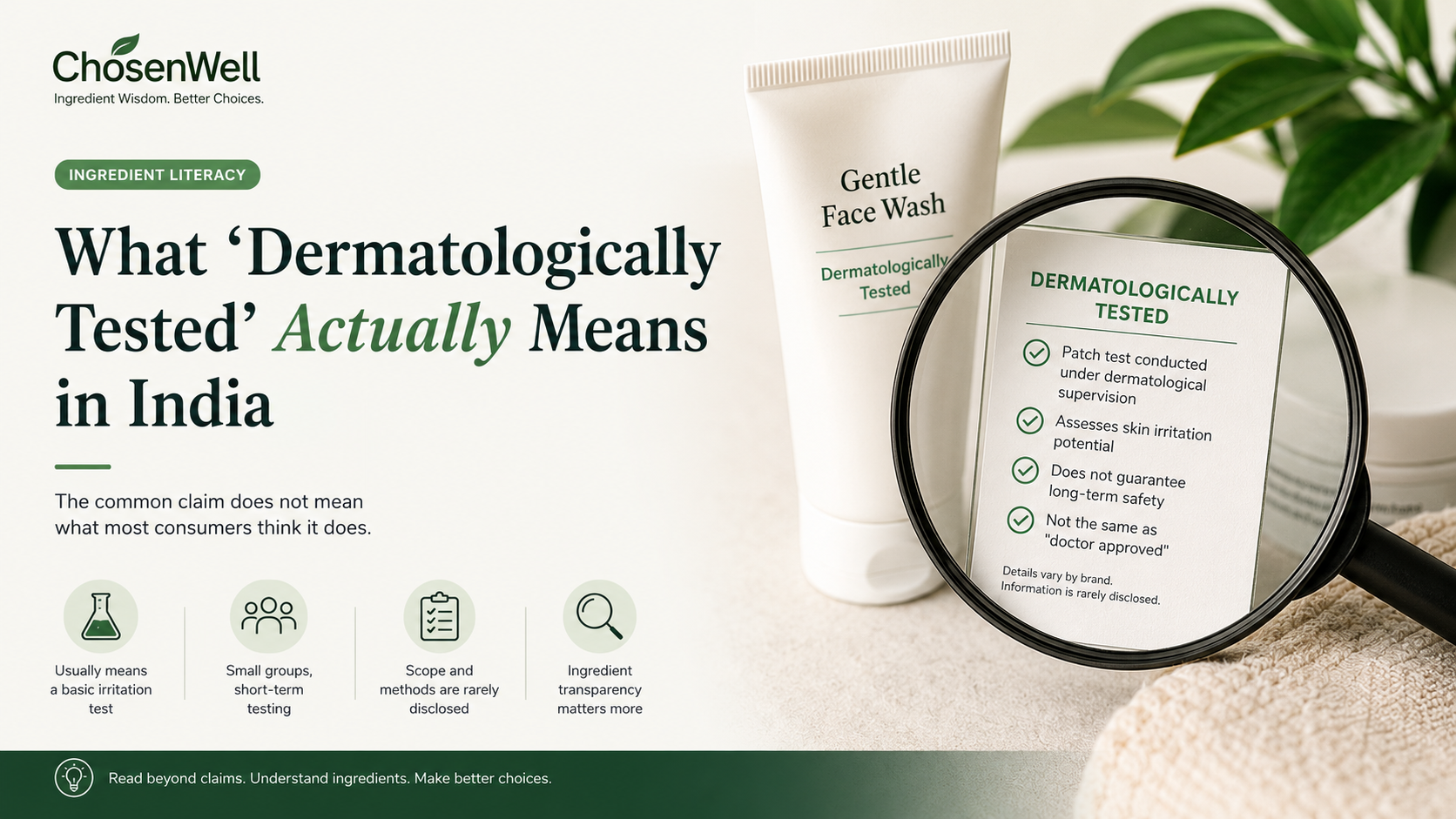
- Dermatologically tested does not mean universally safe.
- The claim usually signals a basic irritation assessment, not long-term safety testing.
- Brands rarely disclose how the testing was conducted.
The words ''dermatologically tested'' appear on everything from face washes to sunscreens and baby products in India. For many consumers, the phrase sounds reassuring — almost medical. It can create the impression that a dermatologist carefully reviewed and approved the product for safety or effectiveness. In practice, the claim often means much less than people assume.
There is no single standard for what qualifies as ''dermatologically tested''. In many cases, it simply means some form of supervised skin testing was conducted. How rigorous that testing was, how many people participated, and what exactly was measured are usually not disclosed.
What the Claim Usually Means
In most practical cases, dermatological testing refers to a basic skin compatibility or irritation assessment. A product may be patch-tested on a small group of participants under the supervision of a dermatologist to check for immediate irritation or allergic reactions.
- A short-term patch or irritation test may have been conducted.
- A dermatologist may have supervised or reviewed the testing process.
- The product may have shown no major irritation in the tested group.
That sounds useful — and it can be — but it is important to understand the limits of what the claim actually communicates.
What ''Dermatologically Tested'' Does NOT Mean
| Common Assumption | Reality |
|---|---|
| Safe for everyone | Skin reactions vary by individual. |
| Doctor approved | Testing is not the same as endorsement. |
| Long-term safety proven | Most testing is short-term. |
| Suitable for sensitive skin | The claim alone does not guarantee this. |
For example, a sunscreen can still contain heavy fragrance, essential oils, or ingredients that irritate some users and still legally carry a dermatologically tested claim. Testing does not eliminate the possibility of irritation — it only suggests that limited testing occurred.
"Think of ''dermatologically tested'' as a weak positive signal — not a trust shortcut. It is better than no testing at all, but it should never replace ingredient awareness."
Why Brands Use the Claim So Heavily
The phrase works well in marketing because it sounds scientific without requiring much explanation. Most consumers interpret it as expert validation, even though the testing details are rarely published publicly.
Unlike certifications that follow defined regulatory frameworks, dermatologically tested claims often lack transparency. Consumers typically do not know:
- How many participants were involved
- Whether testing lasted days or weeks
- Which skin types were included
- Whether sensitive skin users were tested
- What standards were followed
What to Evaluate Instead
Instead of relying only on front-of-pack claims, it helps to evaluate products more broadly.
- Check the ingredient list for common irritants or unnecessary fragrance.
- Look for transparency around testing or formulation.
- Consider whether the formulation matches your skin type and climate.
- Use claims as supporting context — not the main decision factor.
Prioritize full ingredient transparency over reassuring marketing phrases.
Common Questions
Frequently Asked Questions
Does dermatologically tested mean dermatologist approved?
No. Testing and approval are different things. The phrase usually indicates some level of supervised testing, not endorsement.
Does it mean the product is safe for sensitive skin?
Not necessarily. Sensitive skin reactions vary widely and depend on formulation, fragrance, preservatives, and individual tolerance.
Should I ignore the claim completely?
No. It can still be a useful positive signal. Just avoid treating it as proof of superior safety or quality.
Final Takeaway
''Dermatologically tested'' is not meaningless, but it is often misunderstood. In most cases, it signals limited skin compatibility testing — not a guarantee of safety, effectiveness, or suitability for everyone. Treat it as one small input in your decision, not the deciding factor.