Key Takeaways
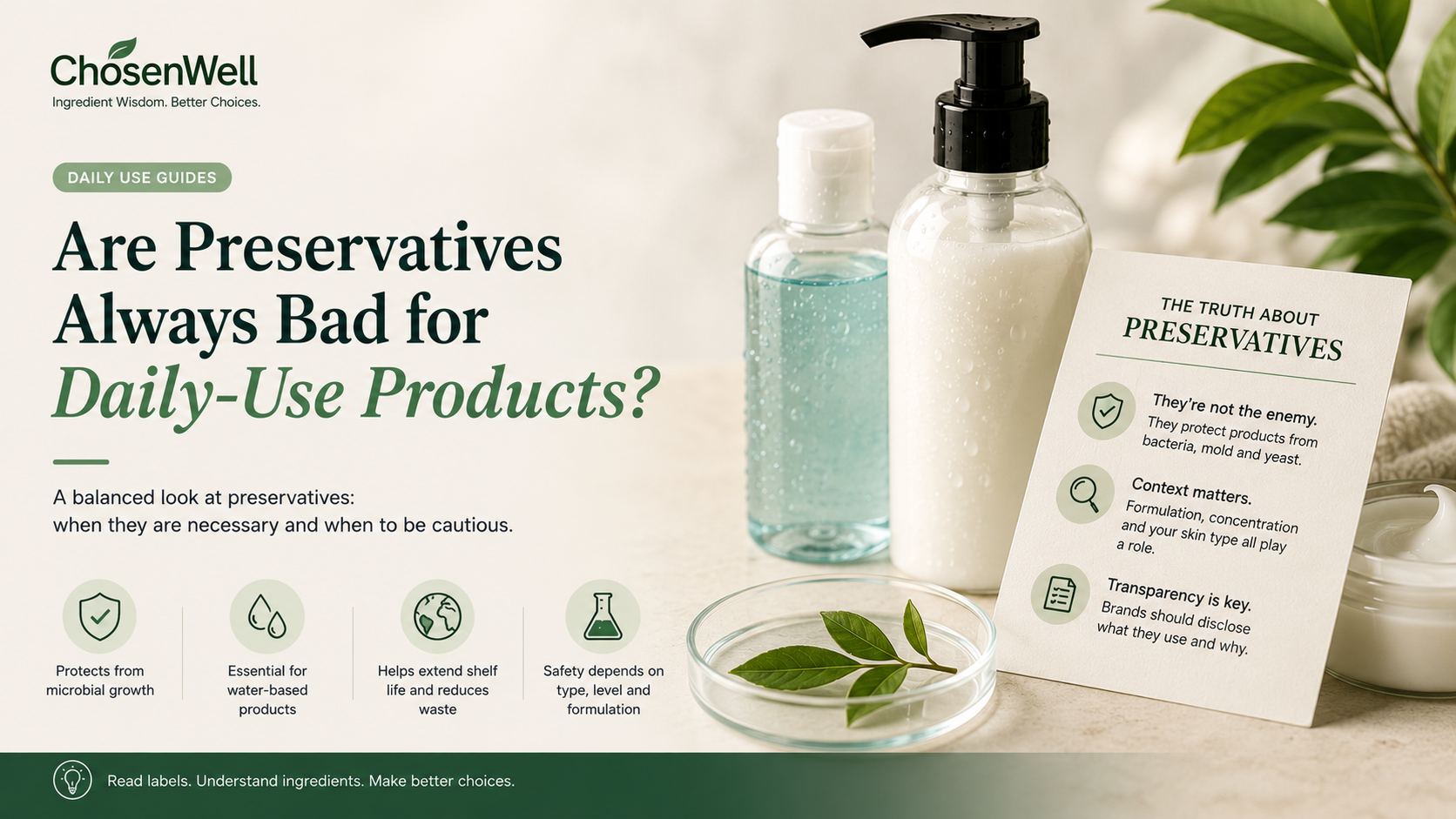
- Preservatives help prevent bacterial, fungal, and mold contamination.
- For water-based products, preservatives are often necessary rather than optional.
- The real question is not whether preservatives exist, but which ones are used and at what level.
Few ingredients trigger stronger reactions online than preservatives. For some consumers, the word itself sounds like a warning sign — something artificial, harsh, or unnecessary. But preservatives exist for a practical reason: products used daily, especially those exposed to moisture and air, can quickly become breeding grounds for bacteria, mold, and yeast without protection.
The discussion becomes confusing because preservatives are often grouped together as entirely good or entirely bad. Reality is more complicated. Some preservative systems are well studied and widely tolerated, while others deserve more caution depending on concentration, formulation, and individual sensitivity.
Why Preservatives Exist in the First Place
If a product contains water, moisture, or repeated hand exposure, preservation becomes important. Shampoo bottles sitting in humid bathrooms, lotions opened daily, or face washes touched repeatedly are all vulnerable to contamination over time.
- Water-based products need microbial protection.
- Repeated exposure to air and fingers increases contamination risk.
- India’s heat and humidity can accelerate microbial growth.
- Preservatives help products remain stable for longer.
Without preservation, even products marketed as clean or natural can spoil faster than expected. In some cases, the absence of preservation can introduce risks that are more serious than the preservative itself.
"A preservative-free label is not automatically a sign of higher quality. For many daily-use products, lack of preservation can create stability and contamination concerns — especially in warm, humid environments."
When Preservatives Are Usually Helpful
| Product Type | Why Preservation Matters |
|---|---|
| Face wash | Repeated contact with water and bathroom humidity. |
| Shampoo | Frequent opening and wet storage environments. |
| Lotions and creams | Water content increases contamination risk. |
| Baby products | Stability matters due to repeated use. |
In practical terms, preservatives are often doing invisible work. They prevent microbial growth that could otherwise lead to spoilage, odor changes, instability, or contamination.
When It Makes Sense to Be More Careful
Not all preservative concerns are imaginary. Certain preservatives have faced scrutiny over irritation potential, sensitisation, or overuse in some formulations.
- Very high fragrance-heavy formulations combined with preservatives may irritate some users.
- Sensitive skin users may react differently to certain preservative systems.
- Transparency matters — vague ingredient disclosure should raise questions.
- Products designed for daily long-term use deserve closer attention.
That said, concentration matters enormously. A preservative that sounds alarming online may exist at a tiny regulated level inside a balanced formulation.
The Bigger Mistake Consumers Make
Many consumers focus on whether a preservative exists instead of asking whether the overall formulation makes sense. Ingredient context matters more than internet lists of ingredients to avoid.
For example, a heavily fragranced product marketed as natural may be more irritating for some users than a transparent, balanced product using a standard preservative system.
Instead of asking ''Does this contain preservatives?'', ask ''Why is this preservative here, and does the overall formulation feel transparent and balanced?''
What to Look for Instead
- Transparent ingredient disclosure
- Preservatives appropriate for product type
- Reasonable formulation balance
- Low reliance on vague marketing claims
- Suitability for your own skin or hair sensitivity
Common Questions
Frequently Asked Questions
Are preservatives harmful in daily-use products?
Not necessarily. Many preservatives are used at regulated levels to prevent contamination and improve stability. Risk depends on the specific preservative, concentration, formulation, and individual sensitivity.
Do natural products need preservatives too?
Often yes, especially if they contain water or are repeatedly exposed to air and moisture. Natural products can still spoil without proper preservation.
Should I avoid products with preservatives completely?
Usually no. For many products, preservatives serve an important purpose. It is often more useful to evaluate the full ingredient list rather than avoid preservatives categorically.
Final Takeaway
Preservatives are not automatically harmful, and in many daily-use products they are doing important work behind the scenes. The more useful question is whether a formulation feels thoughtful, transparent, and appropriate for repeated use. Context matters far more than blanket rules.