Key Takeaways
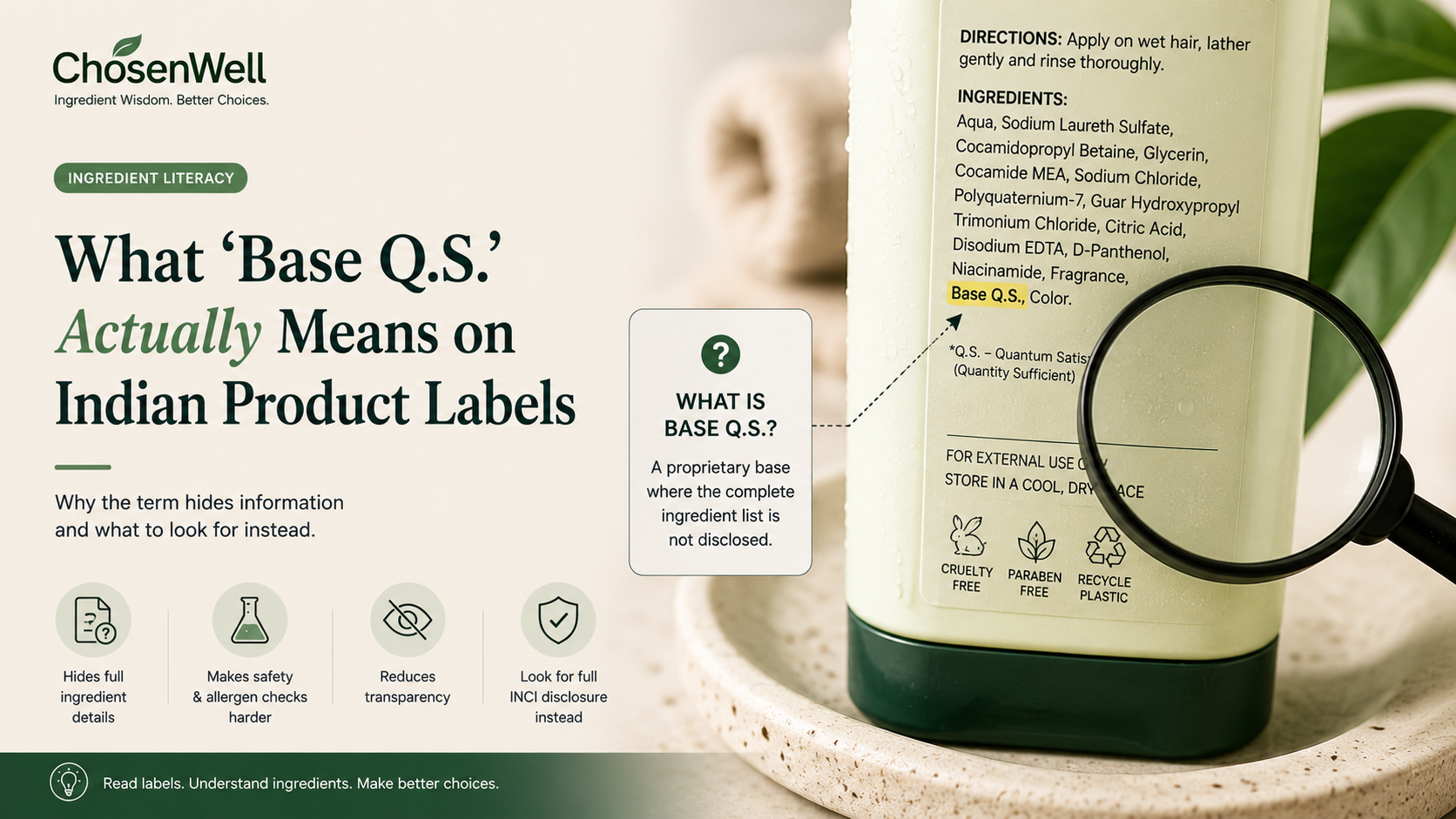
- Base Q.S. usually refers to an undisclosed formulation base used in a product.
- It can reduce ingredient transparency and make evaluation harder.
- The issue is not always safety — it is often lack of clarity.
If you have ever checked the back of a shampoo, soap, or cosmetic label in India, you may have noticed the term ''Base Q.S.'' hidden among ingredients. For many consumers, it sounds technical enough to ignore. But this small phrase matters more than it appears to.
In simple terms, Base Q.S. often acts as a catch-all label for a formulation base whose exact composition is not fully disclosed. Instead of listing every supporting ingredient individually, brands may group parts of the formulation under a broad umbrella term.
What Does Q.S. Actually Mean?
Q.S. stands for the Latin phrase ''quantum satis'', meaning ''as much as sufficient'' or ''quantity sufficient''. In manufacturing, it usually refers to an amount added as needed to complete a formulation.
On Indian product labels, ''Base Q.S.'' generally suggests there is a proprietary or supporting formulation base that has not been individually broken down on the ingredient panel.
Why Brands Use ''Base Q.S.''
There are practical reasons brands may use the term. Some manufacturers treat parts of their formulation as proprietary and may not want to reveal the exact composition publicly. Others may use supplier-provided cosmetic bases or blends where ingredient disclosure becomes less detailed.
- To protect proprietary formulations.
- To simplify ingredient disclosure.
- To avoid revealing exact formulation structure.
- Because some ingredients exist in supporting blends.
The presence of Base Q.S. does not automatically mean a product is poor quality or unsafe. But it does make independent evaluation harder.
Why It Matters for Consumers
| Concern | Why It Matters |
|---|---|
| Transparency | You cannot fully see what makes up the formulation base. |
| Ingredient literacy | Harder to verify whether marketing claims align with formulation. |
| Sensitivity checks | Consumers with allergies or irritation concerns may struggle to evaluate suitability. |
| Comparison | Makes comparing products less straightforward. |
For example, if a product markets itself as gentle or herbal, but much of the formula is grouped under ''Base Q.S.'', consumers cannot easily verify whether the supporting ingredients align with that positioning.
"The biggest concern with Base Q.S. is usually transparency, not immediate danger. Products are easier to evaluate when ingredient disclosure is clear and complete."
Does ''Base Q.S.'' Mean Something Is Being Hidden?
Not necessarily. Sometimes it reflects industry formulation practices rather than intentional concealment. But from a consumer perspective, less disclosure naturally means less visibility into what is actually inside the product.
That becomes more relevant when brands make strong front-of-pack claims around herbs, purity, or ingredient quality while keeping much of the formulation under a broad term.
What to Look for Instead
- Full INCI ingredient disclosure.
- Clear ingredient ordering.
- Transparent formulation language.
- Specific ingredients instead of broad umbrella terms.
- Consistency between claims and formulation visibility.
Prefer products where the majority of ingredients are clearly disclosed and understandable rather than hidden behind broad terms.
Common Questions
Frequently Asked Questions
Is Base Q.S. unsafe?
Not automatically. The issue is usually lack of transparency rather than immediate safety concerns.
Why do brands not disclose everything individually?
Some brands protect proprietary formulations or use supplier-provided bases that are disclosed more broadly.
Should I avoid products with Base Q.S.?
Not always. But products with clearer ingredient disclosure are generally easier to evaluate and compare.
Final Takeaway
Base Q.S. is not automatically a red flag, but it does reduce transparency. For consumers trying to understand what they are actually using daily, clearer ingredient disclosure makes smarter decisions easier. When possible, prefer products that explain their formulations openly rather than hiding large portions behind umbrella terms.